Mentorship
Catalog
Company

Alumni Story
"What are you doing here as a B.Com graduate?"
Mubaid Malik · Senior Cloud Security Engineer, Zscaler
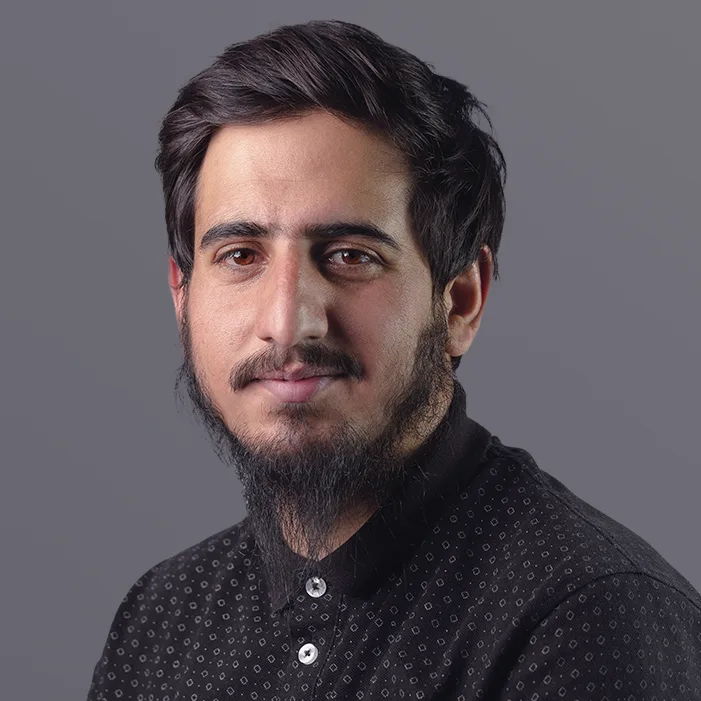

During the spring of 2022, for the first time in seven years since the founding of Techboxx, we sat down with several alumni to hear about their lives and careers. For us, it was a refreshing, necessary experience. The following is one of those conversations, held in a calm, quiet room at the Techboxx campus in Karan Nagar.
“What are you doing here as a B.Com graduate?” exclaimed the recruiter before asking Mubaid to leave.
Mubaid had travelled 2,500 kilometres from Kashmir to Bangalore, then 20–25 kilometres through the city’s notorious traffic to reach Microland’s office. He had presented a three-page CV. None of it mattered.
“This is only for B.Tech students,” the recruiter said, and that was that.
“This left me seriously disheartened,” Mubaid recalls. “For the first time in my life, I had studied with dedication. And now, nothing was happening.”
But not all recruiters think alike, and one has to keep moving forward. It took him another try to find a company that placed more emphasis on skills than a technical degree. Today, Mubaid works at Zscaler as a Senior Cloud Security Engineer.
The one who told him
The spark came from a pamphlet. His cousin (more of a family friend, really) was working at Airtel. One day he handed Mubaid a pamphlet about a Kashmiri network engineer who held the distinction of being the world’s first seven-time CCIE.
“When I read that, I felt something different,” Mubaid says. “Then I looked him up on LinkedIn.”
What he saw was a list of companies that seemed almost fantastical: US Army, HBO, Nestle, ICICI. A career built entirely on having mastered networking.
“You can do MBBS and become a doctor. You may not be known for anything,” he explains. “But the world knows him. His boot camps sell in millions. That was inspiring.”
He makes a compelling observation about why networking worked for him while programming might not have: “There is no inspirational figure in programming, not from Kashmir, at least. If someone has done exceptional work, it’s not in the limelight.” Cisco had professionalised the networking field through its certification system, creating a clear ladder to climb and role models to follow. Programming, vast and fragmented, lacked that same visible pathway.
So Mubaid decided to do his graduation, a B.Com, because it was simple and he knew he could pass the exams with minimal effort, purely for the sake of the degree. The real education would happen elsewhere. This is quite rare and contrary to popular belief: he chose networking before graduating, not after. Graduating from college was for doing CCNA, not the other way around.
Buchpora isn’t far from the centre of Srinagar, where Mubaid grew up. It’s like many other neighbourhoods where hundreds of “aspirants” live: young people trying to figure out their futures.
But Mubaid’s path wasn’t straightforward. Deep family roots lead to business; his grandfather and great-grandfather were core Kashmir Arts businessmen. “I think I’m the first employee in my family,” he says. “Before that, there was no concept of employment.”
He had even tried his hand at business himself, starting a distribution company for imported products: Tong Garden dry fruits, Nestle confectionery, Fox’s candies. “We were first-timers. I think it was too early. I was young then.”
What drove him away from business wasn’t failure but frustration with the lack of structure. “I thought it would be like working in a corporate, with processes. Business in Kashmir, there is no structure. No processes. I used to feel that someone was doing me a favour by letting me have my own money.”
Around the same time, something else was happening. Acute OCD and severe insomnia had almost crippled his early years.
“It’s not that I was working at night,” he clarifies. “I used to lay on my bed until around 6 AM, not sleeping, not doing anything. Just in bed.”
The OCD was worse. “Germophobia. If I touched something, I thought I was dead. Seriously. It was very bad.” He would go to doctors convinced he had psoriasis, convinced he had heart problems. “The doctor told me I had nothing. ECG, TMT, all fine. I used to think the doctor was wrong.”
Part of it, he believes, was his curious nature running without direction. “Dimaag buhat tez chalta tha.” His brain wouldn’t stop. At night, lying in bed, he would think about this business, that business, endless possibilities. “My thinking didn’t have any direction.”
It is worth pausing on that phrase, because it is the diagnosis he returns to for everything else in his life. Not a lack of ability. A lack of direction, and nobody to supply it.
“11th and 12th class, in my opinion, are the most sensitive stages in the life of a youngster,” Mubaid says. “Your company matters a lot.”
His own company during those years wasn’t good. Until 10th grade, he had been a dedicated student, a favourite of his teachers. Then came 11th, and he would leave home supposedly for tuition but go somewhere else entirely. “My friends used to do nothing. So I did nothing.”
The turning point came through religion.
“I knew that if I wanted peace in my life, I knew where it was,” he says. “I just didn’t get that direction. I didn’t get anyone to push me, to say you will find peace in the mosque, or in the Quran.”
He began studying Arabic with a local Molvi Sahib who taught a book by Imam Nawawi. “I won’t say I’m an Allama or someone accomplished as a Muslim. But I had peace because of these things.”
It was this same Molvi Sahib who would later prove instrumental in Mubaid’s career. When Mubaid wanted to pursue CCNA outside Kashmir, his teacher took him along to a gathering after class, where tea was being served at someone’s home. There he met Irfan Sahib in Chanapora, a man who worked at Wipro, and whose colleague was studying CCNA from Junaid Sir at Techboxx.
“Irfan Sahib told me, ‘Don’t go outside Kashmir, you will waste your money,’” Mubaid recalls. He took Umar Sir’s phone number and called Techboxx.
On his first day, Junaid Sir gave a lecture on IP addresses. “I still remember it. I still mention it in interviews,” Mubaid says. “I thought: if I want to learn networking, I have to study with Junaid Sir.”
A pamphlet from a family friend. A cup of tea after an Arabic class. Neither was a plan. Both were somebody saying the right sentence at the right moment, and Mubaid has never forgotten how narrowly he caught them.
”So what?”
After finishing CCNA and CCNP at Techboxx, Mubaid headed to Bangalore in 2018. He had wanted to stay in Kashmir and had tried, but there were no openings, no one to refer him, and no real networking industry to speak of. “At least for coding, you will do freelance, or small companies,” he says. “But for networking, there are no big companies.” Delhi didn’t feel safe. Bangalore had the weather of home. “If there is a livable city in India, then it’s Bangalore.”
Once there, the fancy companies (Wipro, TCS) weren’t considering him because of his B.Com degree. He was disheartened.
“Junaid Sir used to tell me on the phone that these are the fancy companies,” Mubaid recalls. “He said, ‘You will get to know the cream of networking companies in time. It doesn’t matter to them where you are from, if you have B.Com, V.Com.’”
Then came Microland, and the recruiter, and the 2,500 kilometres that counted for nothing.
After that rejection, Mubaid called the Molvi Sahib he had studied Arabic with. The Molvi’s wife had a friend whose husband worked in networking in Bangalore. Mubaid sent his resume.
“He said, ‘We have L0 openings.’ It was a monitoring job.”
L0 was entry-level, just watching dashboards. But Mubaid agreed. “It is okay for now. We will see later.”
When he arrived for the interview at Aryaka Networks, the monitoring team was busy. So someone from the TAC team, a higher level, came down instead. He looked at Mubaid’s three-page resume and asked: “Why are you here for L0?”
“I said, ‘I’m a non-B.Tech graduate.’”
“He said, ‘So what?’”
Mubaid had no answer.
The interviewer started evaluating him for L1 instead. After several rounds, the team manager gave him an unusual assignment: study Linux for a week, then come back.
Mubaid studied, and, quietly, kept interviewing elsewhere at the same time, clearing an L1 round at HP among others. When he returned, the manager asked him about Kashmir, about Pahalgam: casual conversation. Then he explained: “We only wanted to see whether you would go give interviews elsewhere or actually study Linux. We wanted to see if you were serious about this role.”
He was placed at Aryaka Networks on 3rd December 2018 as an L1 engineer.
“I should not use this word,” Mubaid says, “but I will use it. You should know your shit.”
His advice for freshers is blunt: “You will have to struggle. You will get rejected here, rejected there. But you will learn something. At least you’ll know: ‘This is what I need to work on.’”
The key, he says, is pattern recognition. “You’ll understand what networking companies want from you. That will happen only if you apply everywhere, get rejected everywhere, and keep your ego at home.”
He still remembers an interview he failed after Aryaka. “They asked me about operating systems. I didn’t know it. So I studied operating systems.” Now, if he applied again, he’s certain he would get it. “I know what I lacked and have corrected that.”
There was one more thing we wanted to ask about. He had a beard at both stages of his career, we said. There is an impression here about what that means for a Muslim in an Indian corporate office.
“Nothing,” Mubaid replies.
Then he tells a story.
His manager at Aryaka was a non-Muslim. Whenever Mubaid needed to pray, the manager would open his cabin for him and step out. During Ramadan, Mubaid mentioned he needed a break for prayers, but the mosque was far, about as far as here to the Chowk.
One day, the manager went outside for a smoke. He asked Mubaid where the mosque was. Then he walked with him, asking people along the way for directions.
When they found it was too far to walk, the manager came back to the office and sent an email to HR: arrange a company cab for Mubaid from 1:00 to 1:30 PM during Ramadan. The cab would pick him up, wait while he prayed, and bring him back.
“Non-Muslims were very helpful in my case,” Mubaid says. “Outside corporate, I don’t know how they are. But they have a face for corporate which is good for you.”
He makes a sharper observation: “Everyone has two faces. I had a senior director. If you look at his Facebook, he is… not anti-Muslim exactly, but extreme in his views. But his corporate face? He is not biased at all. He treats me the same as everyone else. It is all about data.”
The point is that modern corporate environments, especially in tech, operate on metrics. Who closed more cases? Who has better customer satisfaction scores? “How will he know if your name is Khan or Amrit? Even if they would try, they can’t do it.”
It is the same answer as the TAC interviewer’s, arrived at from the other direction. So what?
Be the one who tells them
One of the reasons young people struggle, Mubaid believes, is the absence of genuine career consultants. “After 11th and 12th, I don’t know what they will teach me in accounting. Or what they will teach me in MBBS. How do I know if I will like it or not?”
The consultants who do exist in Kashmir, he says, are really just admission agents. “If you go to them, they will tell you they will admit you. They don’t tell you anything.”
He envisions something different: experts who can explain what lies behind each field (“such as app development, hacking, web development”) so students can make informed choices. “If there are advisors who will give you advice at the right time, even if that is payable, it is completely worth it.”
He has thought about the delivery, too. A consultant arriving alone at a school will be ignored, he says; the message needs a face people already respect. “So not only the kids, even their parents will take it seriously. We need to take inspirational people with us.”
He sees the responsibility as distributed. Teachers should not only teach their subject but guide students in life. “If you come to Junaid Sir, I have not only studied networking with him. He taught us how to land a job. Even now, if we talk to him, he still guides: ‘It has been some time, you should switch. You should look outside.’”
Religious scholars have a role too. “On Friday sermons, he does not have to just talk about life after death. The Molvi Sahib in your mosque: he should be the first person you look up to, not the last resort.”
And parents bear perhaps the greatest responsibility.
“It is more important to advise parents than to advise the students themselves,” Mubaid says.
He sees a dangerous trend. “In the name of liberalism, we have left children alone. We don’t ask questions to our kids. Where were you? What took so long? We feel that we are going backwards by asking. But these are the questions we should ask.”
His own experience with friends serves as a cautionary tale. “How many of my friends became drug addicts at that age? Are they still there? Because of the same reasons. I used to have probing at home. They didn’t.”
The years from 8th through 12th, he believes, are crucial. “In today’s atmosphere, you have to take care of your kids. When you give them good guidance, they will be serious in studies.”
He is careful not to make it a complaint about the previous generation. Their parents followed the process they were handed. “They didn’t know why to teach,” he says. “They thought: he will get a job. He will get a government job. That’s it.” If they had known why, “they would have consulted a consultant.” The point is not blame; it is that the process stops with whoever refuses to pass it on unchanged.
When asked what advice he would give to students directly, he offers this:
“Whatever field you are studying, there is no field in the world that is bad. Arts, commerce, science: you study it with dedication, you will find a place. Things will fall into place on their own. You just have to be dedicated.”
Mubaid shares one more story about the value of asking.
An HR called him about a position at a company he wasn’t particularly interested in. But when he learned the interview process culminated in a round with the CEO, he agreed to go through with it.
“I thought: I will talk to the CEO. I will get to know how CEOs think, how they speak,” he explains. “Who is the CEO of a big company from Kashmir? You won’t see anyone. How does a person become a CEO? As a founder, CEO is easy. How to become a CEO in a company, that is difficult.”
So he gave an interview he didn’t want, just to reach that final round and ask the question directly: How did you become CEO?
“You should ask people,” he concludes. “Always think they are better than me, they have done something in life. Nine out of ten people will be useless. But one person will give you advice that will change you for a lifetime.”
Mubaid spent two and a half years at Aryaka Networks before moving to Zscaler. He admits the move was partly driven by peer pressure. “Everyone says you have been there more than two years. I felt like I was doing something wrong.”
But he still misses Aryaka. “I still feel that leaving the company was not a mistake, but I miss the work culture, the processes.”
Now at Zscaler, working remotely from Kashmir, he continues to learn and grow. He responds to messages on LinkedIn from freshers asking for guidance, remembering his own anxiety at that stage. “I should not see this and think, ‘Why should I reply?’ I should think: when I was at that stage, what was my anxiety level?”
That is the whole argument, closed. Nobody told him, until somebody did. Now he is the one telling.
This conversation with Mubaid had us deeply engaged for more than an hour. It was a delight to hear him speak his mind: about career, about faith, about the responsibilities we bear toward each other.
Mubaid plans to keep improving and challenging himself. We wish him the best and pray for his continued success.
Mubaid can be reached on LinkedIn. You can DM him for guidance or advice. When you do, let him know this story referred you.


